
Table of Contents
ToggleTable of Contents
- Introduction: The Dawn of a New Judicial Precedent
- Case Background: Pooja Ramesh Singh v. Jammu and Kashmir Bank Ltd.
- Understanding AI Hallucinations in Legal Practice
- The Six Forms of AI-Generated Citation Errors
- Global Precedents: AI Hallucination Cases in Courts
- Legal Consequences of AI-Generated False Citations
- Professional Responsibility and Ethical Obligations
- Best Practices for Verifying AI-Generated Legal Content
- The Future of AI in Legal Research
- SEO Impact and Digital Marketing Implications
- Frequently Asked Questions
- Conclusion and Key Takeaways
1. Introduction: The Dawn of a New Judicial Precedent
Artificial intelligence is transforming the legal profession at an unprecedented pace. From document review and contract analysis to legal research and drafting, AI systems promise efficiency gains that were unimaginable just a decade ago. However, this technological revolution has brought with it a significant risk that has now captured the attention of courts, bar associations, and legal professionals worldwide: AI-generated hallucinations, particularly in the form of fabricated case citations.
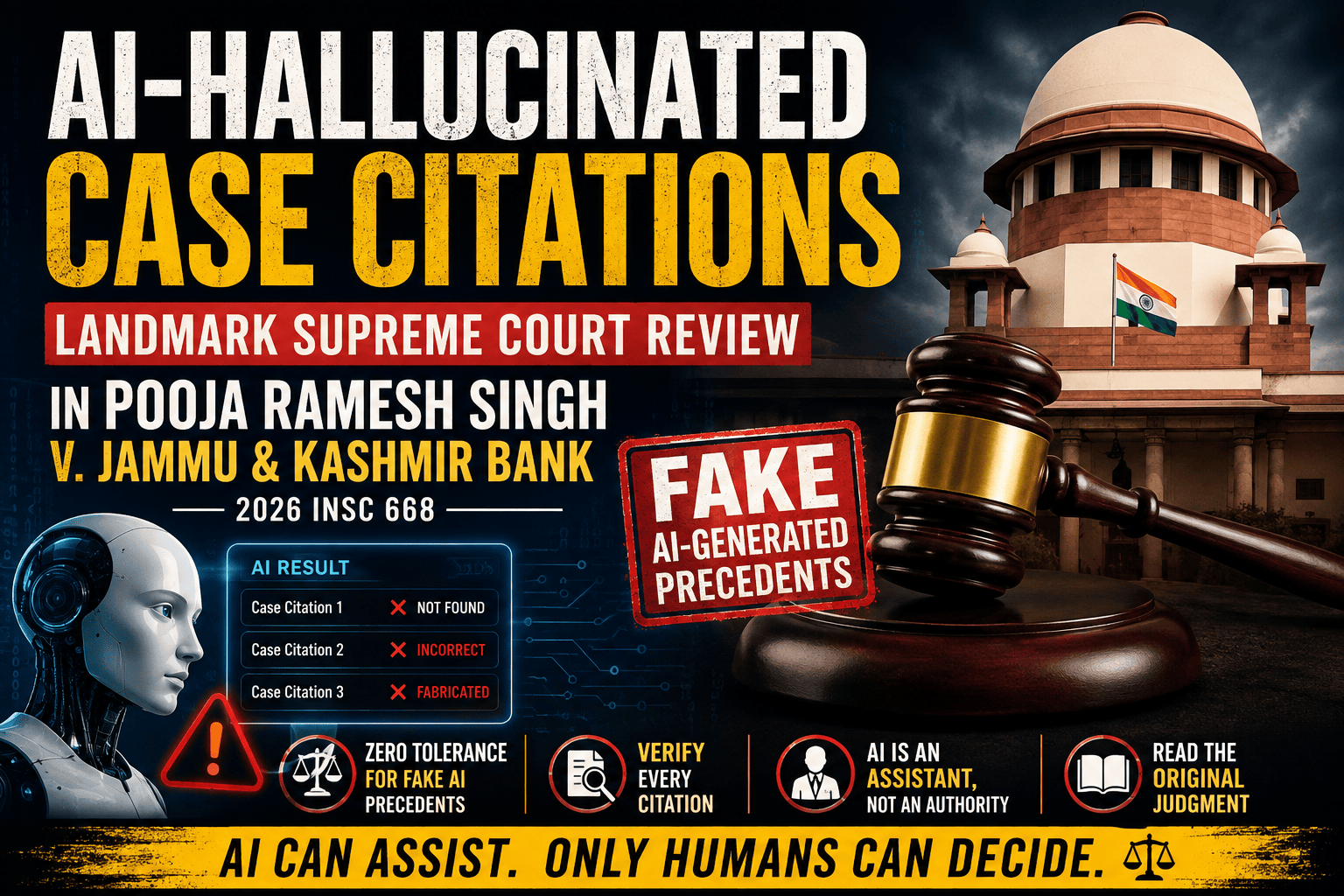
On July 2, 2026, a landmark ruling in Pooja Ramesh Singh v. Jammu and Kashmir Bank Ltd. sent shockwaves through the Indian legal community and beyond. The court quashed orders issued by both the National Company Law Tribunal (NCLT) and the National Company Law Appellate Tribunal (NCLAT), finding that these judicial bodies had relied upon six fake, AI-hallucinated case citations in rendering their decisions. This ruling represents one of the most significant judicial pronouncements addressing the intersection of artificial intelligence and judicial integrity, and it carries profound implications for legal practitioners who increasingly incorporate AI tools into their research workflows.
The judgment underscores a critical tension in modern legal practice: while AI tools offer remarkable capabilities for streamlining research and drafting, the phenomenon of hallucinated citations—where AI systems generate plausible-looking but entirely fabricated legal authorities—poses a direct threat to the integrity of judicial decision-making. As courts across the United States have already sanctioned attorneys for submitting briefs containing AI-generated false citations, the Indian judiciary has now taken a decisive stance on this emerging crisis.
This comprehensive article examines the Pooja Ramesh Singh ruling, contextualizes AI hallucinations within the broader landscape of legal technology, analyzes the multiple categories of citation errors that AI systems produce, and provides actionable guidance for legal professionals seeking to navigate the complex ethical and practical challenges posed by generative AI in legal practice.
2. Case Background: Pooja Ramesh Singh v. Jammu and Kashmir Bank Ltd.
2.1 The Judicial Proceedings
The case of Pooja Ramesh Singh v. Jammu and Kashmir Bank Ltd. arose from proceedings before the National Company Law Tribunal, India’s specialized tribunal established to adjudicate matters relating to corporate law and insolvency proceedings. The NCLT had rendered decisions that were subsequently appealed to the National Company Law Appellate Tribunal (NCLAT), which serves as the appellate forum for NCLT orders.
The central issue that emerged during these proceedings was the discovery that both the NCLT’s original order and the NCLAT’s appellate decision had relied upon six case citations that did not actually exist. These citations, later identified as products of AI-generated hallucination, appeared professionally formatted and legally plausible, yet no such judicial opinions had ever been published. When the matter came before the High Court, the court conducted the necessary verification and determined that the cited authorities were entirely fictitious.
2.2 The Court’s Ruling
The High Court’s ruling on July 2, 2026 was notable for its unequivocal condemnation of reliance upon fabricated legal authorities. The court quashed both the NCLT’s and NCLAT’s orders, holding that judgments premised upon non-existent legal precedents cannot stand as valid judicial determinations. The court reasoned that when a tribunal or court relies upon fabricated case law, the entire foundation of the decision is compromised, rendering the order unsustainable in law.
In delivering its judgment, the court issued a stern warning directed at both the bar and the tribunals: the use of fabricated AI-generated material fundamentally undermines the core trust that underpins the entire judicial decision-making process. This warning carries significant weight, as it signals that judicial bodies and the legal practitioners who appear before them bear a responsibility to ensure that every citation submitted to a court represents a genuine, verifiable legal authority.
2.3 The Broader Implications
The Pooja Ramesh Singh ruling extends far beyond the immediate dispute between the parties. It establishes an important precedent regarding judicial oversight of AI-generated content in legal proceedings. The judgment serves as a reminder that while AI tools can assist in legal research, the ultimate responsibility for the accuracy of every citation lies with the legal professionals who present them to courts and the judicial officers who rely upon them.
This ruling also raises important questions about the duty of judicial officers to verify citations. Historically, courts have relied upon the diligence of counsel to ensure the accuracy of legal authorities cited in arguments and submissions. However, the proliferation of AI-generated hallucinations suggests that all participants in the judicial process—from advocates to judges themselves—must exercise greater vigilance in verifying the existence and applicability of cited authorities.
3. Understanding AI Hallucinations in Legal Practice
3.1 What Are AI Hallucinations?
AI hallucinations occur when generative AI systems produce information that appears plausible and coherent but is factually incorrect or entirely fabricated. In the legal context, this phenomenon is particularly problematic because legal professionals rely upon accurate citations and authorities to build their arguments and render judgments. When AI systems generate false citations, the consequences can range from embarrassing corrections to severe professional sanctions.
The term “hallucinated” legal citation has become a catch-all phrase in the legal community, but understanding its precise meaning requires careful examination. Legal citations contain several essential components: case name, reporter abbreviation, volume and page number, parallel cites, pinpoint cites, court abbreviation, publication year, and parentheticals. When AI systems generate citations, they may produce errors in any or all of these components.
3.2 The Technical Basis of AI Hallucinations
To understand why AI systems hallucinate, it is necessary to understand how large language models (LLMs) operate. These systems are trained on trillions of words which are converted into tokens, with each token mapped to a vector in a high-dimensional embedding space developed during the training process. Words that are likely to occur together in natural language are closer to each other in this embedding space. During training, models learn how to predict sequences of words based on patterns they have observed.
When these predictions miss their mark—when human users do not consider them correct—the errors are called hallucinations. Since current generative AI tools do not provide estimates of the degree of certainty concerning their responses, it can be difficult for end-users to know whether or when a model is hallucinating. The only way to make this determination is to compare AI answers to ground truths, such as checking whether a proffered citation actually exists.
The predictive nature of LLMs means that they generate text that “sounds right” rather than text that “is right.” This fundamental characteristic creates hallucinations that can be dangerously convincing, particularly in legal contexts where professional language and correct formatting are essential.
3.3 Why AI Hallucinations Are Especially Dangerous for Lawyers
When lawyers rely on AI-fabricated information, the consequences extend well beyond simple technical errors. The entire legal system depends upon accurate citation and precedent. Judges rely on attorneys to provide authentic case law that governs disputes, and a fake citation breaks the court’s trust and prevents the judge from ruling fairly.
Courts have limited time to verify every citation presented to them. Judges do not have the resources to serve as personal fact-checkers for every legal submission. Looking for non-existent cases in briefs wastes judicial resources and court time, creating inefficiencies that burden an already overloaded judicial system.
Professional reputation is built on accuracy and trustworthiness. When lawyers submit AI-generated misinformation, they suffer reputational damage that can be permanent. Once a judge stops trusting a lawyer, it is extremely difficult to regain that trust. Moreover, ethical obligations extend beyond what is noticed by opposing counsel or the court—lawyers violate their duty of competence even when their errors go undetected.
Perhaps most importantly, client interests are at stake in every filing. A single hallucinated case can cause a motion to be thrown out, potentially harming the client and leaving the firm open to legal malpractice lawsuits. Public trust in the legal system is undermined when fabricated authorities are filed in court, and protecting against these errors keeps the system fair for everyone.
4. The Six Forms of AI-Generated Citation Errors
AI-generated citation problems manifest in several distinct forms, each presenting unique challenges for verification and correction. Understanding these categories is essential for legal professionals seeking to identify and address hallucinated citations in their work.
Let’s examine each of these six categories of errors:
4.1 Complete Fabrication
The most common and dangerous form of AI citation hallucination is complete fabrication. In this scenario, the AI invents a citation that simply does not exist. No court has ever published an opinion with that reporter citation, and the citation is entirely fictitious.
This form of hallucination occurs when AI systems generate plausible-looking citations by combining real court names, case formats, and publication information in ways that appear authentic but have no basis in reality. For example, an AI might create a citation that combines a real court name with a fictitious party name, producing something that looks like a legitimate legal authority but is entirely fabricated.
The danger of complete fabrication lies in its believability. AI systems are remarkably effective at producing text that follows the conventions of legal citation formatting, including correct abbreviations, proper parallel citation structures, and plausible publication years. Without direct verification against legal databases, even experienced attorneys may be fooled by these fabricated citations.
4.2 Mismatched Components
The second category of AI citation errors involves mismatched components. In these cases, either the case name is fabricated but the reporter citation is real, or the case name is real but the reporter citation is fake.
This form of hallucination creates a unique verification challenge. When a citation contains some genuine components and some fabricated ones, it may appear to be a legitimate authority to a casual reviewer. The real components lend credibility to the overall citation, making it more difficult to detect the error without thorough verification.
For example, an AI might generate a citation that uses a real case name from a well-known case but pairs it with a reporter citation that does not exist. Alternatively, the AI might use real reporter information but match it with a case name that has no basis in reality. Both scenarios create citations that are partially authentic and partially fabricated, requiring careful examination to identify.
4.3 Correct Citation with Inaccurate Details
The third category involves correct citations that contain inaccurate details. In these cases, the case name and reporter citation are correct, but more nuanced portions are wrong. Examples include a pinpoint cite to a page outside the case’s actual page range, an incorrect court level, an inaccurate year, or misquoted language.
This is a particularly insidious form of hallucination because the citation appears to be genuinely verifiable. The case exists, the reporter citation is accurate, and most of the information checks out. However, the specific details that give the citation its legal significance—such as the pinpoint page where a particular holding appears or the court that decided the case—are incorrect.
These errors can arise in several ways. The AI may have encountered fragmented information during training and filled in gaps with plausible guesses. Alternatively, the AI may have confused details from different cases or misremembered specific aspects of a genuinely existing case. Regardless of the cause, these errors can lead legal professionals to rely on incorrect aspects of accurate cases.
4.4 Correct Case, Wrong Proposition
The fourth category of AI citation errors involves cases that are accurate in their citation details but do not actually stand for the proposition that the AI claims they do. All the case details are accurate—the case exists, the citation is correct, and the case is discoverable—but the case does not actually support the legal argument being made.
This form of hallucination is particularly tricky because it requires substantive legal analysis to detect. Unlike other forms of hallucination that might be caught through basic citation verification, this error requires the legal professional to read the actual case and evaluate whether it truly stands for the proposition being asserted.
AI systems generate this type of error when they misunderstand or misrepresent the actual holdings of cases. The AI may have observed patterns suggesting that a particular case is commonly cited for a certain proposition and assumed that connection without properly understanding the case’s actual legal significance. This highlights the importance of reading cases in full rather than relying on AI-generated summaries or characterizations.
4.5 Overturned Precedent
The fifth category involves cases where the citation details are correct, and the case originally stood for the cited proposition, but the case has since been overturned and is no longer good law.
This situation creates particular challenges because the citation itself is genuine, and the case did at one time support the proposition being asserted. However, subsequent legal developments have invalidated the case as authoritative precedent, and citing it as current good law is misleading.
The example of Loper Bright overturning Chevron deference illustrates this category well. Before Loper Bright, citations relying on Chevron deference were valid authorities. After Loper Bright overturned Chevron deference generally, any AI citations relying on Chevron could be misleading because the foundational support for those arguments has been removed.
4.6 Subsequently Distinguished Precedent
The sixth category involves cases that are correct in their citation details, stand for the cited proposition, and have not been overturned generally—but courts in the relevant jurisdiction have recently distinguished or declined to apply the case on the particular issue at hand.
This final category represents a sophisticated form of legal analysis that often escapes AI detection. The case remains valid law, but its applicability to the specific factual scenario or legal issue in question may have been limited by subsequent decisions.
For example, if the Nth Circuit recently held that Provision X in employment contracts is null and void, AI might cite pre-existing precedent upholding the provision without recognizing that subsequent case law has changed the landscape. The pre-existing precedent still exists and has not been overturned, but its applicability has been fundamentally altered by the more recent decision.
Table 4.1: Six Categories of AI-Generated Citation Errors
| Category | Case Name | Reporter Citation | Case Exists | Case Supports Claim | Good Law | Verification Complexity |
|---|---|---|---|---|---|---|
| 1. Complete Fabrication | Fake | Fake | No | N/A | No | Moderate |
| 2. Mismatched Components | Either real or fake | Either real or fake | Partially | Variable | Variable | Moderate |
| 3. Correct Citation, Inaccurate Details | Real | Real | Yes | Variable | Usually | Low-Moderate |
| 4. Correct Case, Wrong Proposition | Real | Real | Yes | No | Yes | High |
| 5. Overturned Precedent | Real | Real | Yes | Originally | No | Moderate-High |
| 6. Distinguished Precedent | Real | Real | Yes | Yes | Yes, but limited | High |
The following visualization illustrates the classification of AI hallucinated citations and their legal implications:
flowchart TD
    A["AI-Generated Citation"] --> B{"Does the Citation Exist?"}
    B -->|"No"| C["Complete Fabrication"]
    C --> C1["No court has published this case"]
    C1 --> C2["Most common & dangerous type"]
    B -->|"Partially"| D["Mismatched Components"]
    D --> D1["Either case name or reporter is fake"]
    B -->|"Yes"| E{"Are All Details Accurate?"}
    E -->|"No"| F["Inaccurate Details"]
    F --> F1["Wrong pinpoint, court, year, or quote"]
    E -->|"Yes"| G{"Does Case Support Claim?"}
    G -->|"No"| H["Wrong Proposition"]
    H --> H1["Case details correct but meaning mistaken"]
    G -->|"Yes"| I{"Is Case Still Good Law?"}
    I -->|"No"| J["Overturned Precedent"]
    J --> J1["Overruled or superseded"]
    I -->|"Yes"| K{"Still Applicable on This Issue?"}
    K -->|"No"| L["Distinguished Precedent"]
    L --> L1["Courts recently declined to apply"]
    K -->|"Yes"| M["Valid Citation"]
    M --> M1["Properly verifiable authority"]
Figure 4.1: Classification Flowchart of AI-Generated Citation Errors in Legal Practice
5. Global Precedents: AI Hallucination Cases in Courts
The Pooja Ramesh Singh ruling is part of a growing global pattern of judicial responses to AI-generated hallucinated citations. Understanding these international precedents provides important context for evaluating the significance of the Indian court’s decision.
5.1 Mata v. Avianca, Inc. (2023)
The landmark Mata v. Avianca case represents one of the first and most widely publicized instances of AI-generated citations in American legal practice. In this case, a lawyer used ChatGPT to find precedents for a brief, and the AI generated completely fabricated legal citations for six cases. When the court could not find the cases, the lawyer asked the AI whether the cases were real, and the AI falsely confirmed they were.
The attorney’s failure to cross-reference cases in legal research databases resulted in court sanctions and a $5,000 fine. This case, decided by Judge Kevin Castel in the Southern District of New York, established an important precedent for the consequences of relying on unverified AI-generated legal research.
Judge Castel conducted his own search for the citations when opposing counsel reported that they could not locate them. When the citations could not be found in any legal database, the court determined that the attorneys had submitted fabricated authorities and imposed sanctions for this unprofessional conduct.
5.2 Park v. Kim (2024)
In Park v. Kim, an attorney submitted a motion containing multiple fake legal citations generated using a ChatGPT prompt. The appellate judges noticed the errors during their internal research, discovering that the brief cited non-existent cases and used imaginary case numbers.
The court noted that the lawyers failed to meet the required standard of competence, and the matter was referred to the grievance committee for attorney discipline. This case illustrates that courts are actively checking AI-generated citations and are prepared to impose real consequences on attorneys who fail to meet their professional obligations.
5.3 Moffatt v. Air Canada (2024)
The Moffatt v. Air Canada case demonstrates that AI hallucination issues extend beyond the legal profession itself. In this case, an AI chatbot on an airline’s website confidently stated false information regarding its bereavement refund policy. The AI informed a passenger that they could apply for a refund after booking their flight, which contradicted the airline’s actual policy.
When the passenger sued, the airline claimed that it could not be liable for the AI chatbot’s responses. The tribunal rejected this argument, ruling that the company was liable for the AI’s fictitious promises. This case establishes that organizations relying on AI outputs require the same level of due diligence as individual researchers.
5.4 Ko v. Li (2025)
In Ko v. Li, an Ontario case, a lawyer relied on ChatGPT for legal research and submitted a notice of motion that included fake case citations provided by the AI. Opposing counsel attempted to verify the citations in legal research databases and exposed the fabricated case law to the court.
The lawyer admitted that they did not validate the fabricated case law before filing. The judges issued a formal warning, noting that unchecked AI use creates systemic risk for the entire profession. This case reinforces why manual verification systems are essential for all legal professionals, regardless of jurisdiction.
5.5 Deghani v. Castro (2025)
The case of Deghani v. Castro, from the U.S. District Court in New Mexico, illustrates the issue of attorneys not understanding technology and its potential misuse. The plaintiff’s attorney, Felipe Millan, contracted with a freelance attorney to conduct research, and the freelancer returned a brief with several hallucinated cases, which Millan did not check.
The court referred Millan to the state bar for sanctions, and when Millan argued that his good intentions should mitigate the punishment, the court rejected this argument. The court noted that “the standard under Rule 11 is one of objective reasonableness—the imposition of sanctions does not require a finding of subjective bad faith by the offending attorney. An attorney who acts with ‘an empty head and a pure heart’ is nonetheless responsible for the consequences of his actions”.
5.6 Kaur v. Desso (2025)
In Kaur v. Desso, from the U.S. District Court in the Northern District of New York, the court found that the plaintiff’s attorney “admits that he was aware at the time that AI tools are known to ‘hallucinate’ or fabricate legal citations and quotations,” but he felt pressured to rush the pleading due to imminent deportation. The court imposed a $1,000 fine and mandated CLE training on AI for the attorney, saying that the need to check whether the assertions and quotations generated were accurate trumps all.
5.7 The Williams Decision (Oregon)
An Oregon appeals court decision in Williams addressed the issue of lawyers submitting AI-hallucinated or fabricated citations, emphasizing Rule 3.3’s duty of candor to both the court and opposing counsel. The court criticized the lawyer not only for including fabricated authorities but also for attempting a “quiet correction” without acknowledging the problem.
The panel discussed growing judicial frustration, the likelihood of sanctions and disciplinary referrals, and examples of suspensions. This case emphasizes that generative AI hallucinations are inherent, so lawyers must verify every citation by checking links and reading cases, use appropriate research tools, learn effective prompting techniques, and promptly disclose and remedy any errors rather than conceal them.
Table 5.1: International AI Hallucination Cases and Their Consequences
| Case Name | Court | Year | Nature of Error | Consequence |
|---|---|---|---|---|
| Mata v. Avianca | S.D.N.Y. | 2023 | Six fabricated citations | $5,000 fine, sanctions |
| Park v. Kim | Appellate Court | 2024 | Multiple fake citations | Referral to grievance committee |
| Moffatt v. Air Canada | Tribunal | 2024 | AI chatbot false policy info | Company held liable |
| Ko v. Li | Ontario Court | 2025 | Fake citations in notice of motion | Formal warning to attorney |
| Deghani v. Castro | D.N.M. | 2025 | Hallucinated cases in brief | Referral to state bar |
| Kaur v. Desso | N.D.N.Y. | 2025 | Fabricated citations | $1,000 fine, CLE training |
| Pooja Ramesh Singh | High Court (India) | 2026 | Six fake citations | NCLT/NCLAT orders quashed |
6. Legal Consequences of AI-Generated False Citations
6.1 Court Sanctions and Attorney Fees Awards
Courts across the globe have demonstrated a willingness to impose significant sanctions on attorneys who submit AI-generated false citations. Judges often order lawyers to pay the other side’s legal fees as a consequence of submitting fabricated authorities. These monetary sanctions serve both a punitive and deterrent function, signaling that misuse of AI tools in legal practice will not be tolerated.
The Mata v. Avianca case established this pattern with its $5,000 fine imposed on the attorneys who relied on ChatGPT-generated citations without verification. Subsequent cases have continued this trend, with courts imposing fines, requiring CLE training on AI, and referring attorneys to disciplinary authorities.
6.2 State Bar Disciplinary Proceedings
Legal ethics committees may investigate lawyers who submit AI-generated false citations, and these investigations can lead to serious consequences including disbarment risks. The referral of attorneys to grievance committees and state bar disciplinary proceedings represents a significant professional threat that extends beyond immediate monetary sanctions.
In the Park v. Kim case, the court’s referral to the grievance committee signaled that AI misuse would be treated as a serious ethical violation rather than a minor procedural error. This approach reflects a growing consensus that the submission of fabricated citations—regardless of their origin—constitutes a violation of fundamental professional obligations.
6.3 Malpractice Claims and Professional Liability
Clients can sue attorneys for professional negligence when AI hallucinations harm their cases. Such claims can increase malpractice insurance premiums and expose lawyers to significant financial liability. When an attorney submits a brief containing fabricated citations and the case is dismissed as a result, the client may have valid claims for legal malpractice.
The risk of malpractice claims is particularly acute in cases where strategic decisions are made based on misunderstood legal frameworks. As one source notes, an attorney might advise a client to settle based on a fictitious rule, leading to financial harm that could have been avoided with proper legal research. Third, this creates liability exposure not only for the attorney but potentially for the law firm as an entity.
6.4 Loss of Client Trust and Damaged Reputation
Reputational damage from AI hallucination incidents is often permanent. Peers and clients may lose faith in a lawyer’s work after discovering fabricated citations, and once a judge stops trusting an attorney, it is difficult to regain that trust. Professional reputation is built over years of accurate, reliable work, and a single incident of AI misuse can undermine that foundation.
The damage extends beyond individual attorneys to their firms. When a firm becomes known for submitting fabricated citations, every future filing will be scrutinized more carefully. This increased scrutiny creates inefficiencies and delays, and it signals to clients that the firm’s work product may not be reliable.
6.5 Negative Precedent Affecting AI Adoption
Every failure involving AI-generated false citations leads to more judicial skepticism regarding legal AI tools. This skepticism can slow the adoption of legitimate AI tools that offer genuine benefits to legal practice. When courts become wary of AI-generated content, they may scrutinize all technological tools more carefully, creating barriers to innovation.
The cumulative effect of AI hallucination cases could be a more cautious approach to AI adoption across the legal profession. While some caution is appropriate given the risks, an overly restrictive approach could prevent lawyers from benefiting from legitimate AI tools that enhance efficiency and accuracy when used properly.
6.6 Permanent Record and Systemic Risk
As the Ko v. Li court noted, unchecked AI use creates systemic risk for the entire profession. Each instance of AI hallucination in legal filings creates evidence that becomes part of the judicial record. More than 900 cases of AI hallucinations have been documented in a database tracking these incidents, with the majority involving fabricated citations.
The systemic nature of this risk means that individual failures have consequences that extend beyond the specific cases in which they occur. Each fabricated citation undermines confidence in the legal system and creates additional burdens for courts attempting to distinguish legitimate authorities from AI-generated fictions.
7. Professional Responsibility and Ethical Obligations
7.1 The Professional Responsibility Framework
Verification of AI-generated content is not merely a best practice—it is an ethical obligation. The professional responsibility framework for AI verification encompasses several key duties that legal professionals must fulfill to maintain their ethical obligations.
Competence: Lawyers must understand the legal risks of the technological tools they use. This includes knowing that AI is a generative tool, not a search engine, and recognizing its propensity for hallucinations. Model Rule 1.1 requires attorneys to provide competent representation, which now encompasses understanding how AI tools work and their limitations.
Diligence: Attorneys must perform a de novo (from the beginning) review of all AI-generated content. They must never “copy-paste” without validation. The duty of diligence requires careful attention to every detail of client representation, including the verification of all legal authorities cited in filings.
Candor toward the Tribunal: Lawyers must ensure that court clerks and judges receive accurate information. Every citation and factual claim submitted to the court must be verified in a primary source database. Rule 3.3 imposes an affirmative duty of candor that extends to AI-generated content.
Supervision: Law firm partners must monitor how junior lawyers use AI tools. All firm members and staff must follow a strict “Human-in-the-Loop” (HITL) protocol before any work product leaves the firm. This supervisory responsibility is essential for preventing AI misuse throughout the organization.
7.2 ABA Formal Opinion 512
The American Bar Association issued Formal Opinion 512 in July 2024, providing guidance on the responsible use of GenAI tools in legal practice. This formal opinion addresses the ethical considerations arising from the integration of generative AI into legal workflows.
Formal Opinion 512 reinforces that existing ethical rules apply to AI-assisted legal work. The need for competent representation, effective communication with clients, and protection of confidential information has not changed with the advent of AI tools. Lawyers must understand how AI fits into the ethical framework that has always guided proper lawyering.
7.3 The AI Disclosure Requirement
As legal systems continue to adapt to AI technology, many jurisdictions have implemented mandatory “AI Disclosure” certificates where lawyers must sign a statement swearing they have manually verified any AI-generated citations. These requirements reflect a growing recognition that AI-generated content requires special attention and that lawyers must take affirmative steps to verify AI outputs.
These disclosure requirements serve several purposes. They ensure that lawyers understand when they are relying on AI-generated content, they create a paper trail that facilitates accountability, and they signal to courts that the attorney has taken the necessary steps to verify AI outputs before submission.
7.4 The “Never Trust, Always Verify” Principle
The National Center for State Courts has articulated a clear principle for legal professionals using AI tools: “Never trust, always verify.” This principle requires that legal professionals check every citation, case, statute, rule, and claim generated by AI before relying upon it.
This verification principle extends to all aspects of AI-generated content. Legal professionals must verify that cited authorities actually exist, that they support the propositions for which they are cited, and that they remain good law. Verification must be conducted using primary sources and authoritative legal databases rather than relying on AI-generated summaries or confirmations.
8. Best Practices for Verifying AI-Generated Legal Content
Given the significant risks associated with AI-generated citations, legal professionals must implement systematic verification frameworks to ensure the accuracy of all AI-derived content.
8.1 Verification Protocols
Verify Every Case Citation in Primary Sources: Always manually confirm the existence, content, and current status of every citation using a verified legal database (e.g., Westlaw, LexisNexis, Bloomberg Law) or official court records.
Check Statutory References Against Official Code Databases: Use official government sites, such as govinfo.gov, to validate that a cited law exists and to confirm its exact text.
Confirm Case Holdings by Reading Actual Opinions: Never trust an AI’s summary of a case. Read the full text of cited opinions to detect inaccurate legal analysis and confirm that the case actually stands for the proposition being asserted.
Cross-Reference AI Outputs With Multiple Authoritative Sources: If an AI provides a case name, investigate it directly in an official reporter. Never rely on one AI tool to confirm the work of another, as multiple AI systems may suffer from the same hallucination patterns.
Use AI as a Research Starting Point, Never as a Final Authority: Use AI tools to identify potential authorities and generate research leads, but verify every result manually before relying upon it.
8.2 Institutional Safeguards
Establish Firm-Wide Verification Protocols: Set clear rules for how legal researchers use AI throughout the organization. These protocols should address when AI tools may be used and what verification steps are required.
Create Checklists for Various Document Types: A legal brief requires more verification than a simple email or internal memorandum. Different document types should have different verification requirements based on their importance and the consequences of errors.
Assign Verification Responsibility Explicitly: Ensure that a specific individual is assigned to authenticate AI-generated output. Having a named person responsible for verification creates accountability and ensures that verification is not overlooked.
Train All Lawyers on Hallucination Risks: Everyone in the organization must understand that AI produces confidently stated false information. Training should address how hallucinations occur, what they look like, and how to prevent them from reaching court filings.
Maintain Healthy Skepticism of AI Confidence: Just because an AI sounds convincing does not mean it is correct. Legal professionals must maintain a critical perspective on AI outputs and verify information independently.
8.3 Effective AI Prompting Techniques
While improved prompting cannot eliminate hallucinations entirely, effective prompting techniques can significantly reduce their frequency and improve the quality of AI-generated research outputs.
Request Citations to Specific Authoritative Sources: Tell the AI to reference only specific books, such as the Supreme Court Reporter or other designated reporters.
Ask AI to Flag Uncertainties in Its Responses: Instruct the AI: “If you aren’t 100% sure a case is real, tell me.” This instruction encourages the system to identify potential hallucinations rather than presenting fabricated information with confidence.
Break Complex Research Into Verifiable Steps: Don’t ask for a whole memo at once. Ask for a case name first, verify its existence, then ask for details. This step-by-step approach facilitates verification at each stage of the research process.
Explicitly Instruct AI to Indicate When Information Might Be Uncertain: Tell the AI: “Do not give me a citation if you can’t find the page number.” These constraints force the AI to be more careful about the information it provides.
8.4 The Verification Workflow
The following visualization illustrates the recommended workflow for verifying AI-generated legal content:
flowchart TD
    A["AI-Generated Legal Content"] --> B["Initial Human Review"]
    B --> C{"Citation Present?"}
    C -->|"No"| D["Assess Substantive Content"]
    C -->|"Yes"| E["Verify Citation Exists"]
    E --> F["Check Primary Source Database"]
    F --> G{"Citation Found?"}
    G -->|"No"| H["Reject Citation"]
    G -->|"Yes"| I["Read Full Opinion"]
    I --> J{"Case Supports Proposition?"}
    J -->|"No"| K["Reject or Reframe Argument"]
    J -->|"Yes"| L["Check Current Precedential Status"]
    L --> M{"Is Case Good Law?"}
    M -->|"No"| N["Find Alternative Authority"]
    M -->|"Yes"| O{"Recent Distinguishing Cases?"}
    O -->|"Yes"| P["Address Distinctions"]
    O -->|"No"| Q["Use Citation in Filing"]
    H --> R["Document Verification Process"]
    K --> R
    N --> R
    P --> R
    Q --> R
    R --> S["Multiple Reviewers"]
    S --> T["Final Approval Before Filing"]
Figure 8.1: Verification Workflow for AI-Generated Legal Citations
9. The Future of AI in Legal Research
9.1 AI’s Growing Role in Legal Workflows
The integration of AI into legal practice is accelerating, with more than 90% of legal professionals expressing belief that AI will be central to their workflow within the next five years. This widespread adoption reflects the genuine benefits that AI tools offer for streamlining research, drafting, and analysis. However, it also amplifies the importance of understanding and managing hallucination risks.
AI tools are transforming legal work with the ability to scan millions of cases, statutes, and regulations in seconds. These systems use machine learning, natural language processing, and large language models trained on vast legal datasets to “understand” legal terminology and concepts within their specific domains, providing insights, identifying relationships, and generating content requested by a user.
9.2 Purpose-Built Legal AI Tools
The legal technology market has responded to hallucination concerns by developing purpose-built legal AI tools that are trained extensively on legal data. These tools offer improved accuracy compared to general-purpose AI systems because of their specialized training and focus.
Tools like CoCounsel, Westlaw Edge, and Harvey AI can significantly reduce the time required to review case law, summarize data, and flag potentially useful information. These tools are designed with legal-specific considerations that general-purpose AI tools lack, including improved citation handling and verification mechanisms.
However, even purpose-built legal AI tools are not infallible. As one analysis notes, “given the nature of how the technology predicts the next word in a sequence, including generated legal citations, by definition no GenAI tool will be accurate 100% of the time”. The key to preventing errors remains human intuition and checking research results before any brief or document is submitted.
9.3 The Evolution of Legal AI from RAG to Knowledge-Based Systems
Emerging legal AI technologies are moving beyond traditional retrieval-augmented generation (RAG) approaches toward more sophisticated knowledge-based, mind-mapping strategies. These next-generation tools create relational knowledge maps of the data before offering answers or agentic services, representing a critical phase where legal AI can begin to truly transform the quality of legal practice.
The acquisition of DeepJudge by Thomson Reuters and its integration into Westlaw’s CoCounsel Legal signals this shift. DeepJudge promises “Holistic, Multi-level Search” that combines data about clients, matters, documents, and people across all data sources to deliver the most relevant information.
9.4 Balancing AI Benefits and Risks
The future of AI in legal practice requires striking a careful balance between leveraging the genuine benefits of AI tools and managing their inherent risks. As one legal professional observed, “Not using such a powerful tool to analyze and synthesize vast volumes of information at speeds beyond human capacity would be a missed opportunity, despite its known pitfalls: bias, hallucinations, and sycophantism”.
Legal professionals who understand both the law and the tools will set the direction of this evolution. The legal profession is not disappearing; it is evolving, and lawyers who genuinely understand AI’s capabilities and limitations will be best positioned to use these tools effectively while protecting their clients and their professional obligations.
10. SEO Impact and Digital Marketing Implications
10.1 The Intersection of AI Hallucinations and Legal SEO
The Pooja Ramesh Singh ruling has significant implications for legal digital marketing and search engine optimization. As clients increasingly turn to online search to find legal representation, law firms must establish authoritative digital presences that demonstrate expertise and trustworthiness. However, the AI hallucination crisis introduces new complexities into legal content marketing.
Recent research has confirmed that law has the most competitive keywords in search. To rank above the significant competition, a lawyer’s SEO content needs to precisely target the intent behind those search terms. This requires content that is not only keyword-optimized but also substantively accurate and authoritative.
10.2 The Critical Role of Fact-Checking in Legal Content
Using AI content verbatim for legal content can be risky, given the high error rate that plagues AI-generated content. The Columbia Journalism Review found that, when asked to find sources for a quote, chatbots returned incorrect answers 60% of the time. Any factual inaccuracy reflects poorly on a firm, and fact-checking is the minimum human input necessary for reliable content.
Most AI-produced work needs significant human revision to flow smoothly. However, an outline or first draft from an AI tool offers a great place to start for legal content marketing. The key is recognizing that AI-generated content requires substantial human oversight before publication.
10.3 Authority and Trust in the Age of AI Search
Search engines are testing features that generate complete, conversational summaries at the top of the results page, pulling information directly from authoritative websites. To appear in these AI-generated summaries, law firms must build a cohesive, highly trustworthy digital footprint backed by strong peer and client reviews.
Content that demonstrates real legal expertise through deep topical clusters, authoritative citations, and nuanced distinctions is becoming increasingly important. Even when informational queries generate few clicks—because AI answers inline and citations see lower click-through rates than blue links ever did—that content still signals topical authority. AI systems then use that authority to surface firms in commercial results where business actually happens.
10.4 Content Strategy Implications
For law firms, the AI hallucination crisis reinforces the importance of content that reflects how the law operates in practice, not just how keywords are searched. The audience isn’t always the searcher anymore; it’s the AI. This means content must be structured and substantive enough for AI systems to recognize as authoritative, while still being accurate and verifiable by human readers.
In the legal context, demonstrating authority requires statutory citations, case law, breakdowns of elements, and the ability to distinguish between similar legal concepts. This rigor is valuable both for SEO purposes and for maintaining the firm’s reputation for accuracy and expertise.
11. Frequently Asked Questions
11.1 What exactly happened in Pooja Ramesh Singh v. Jammu and Kashmir Bank Ltd.?
On July 2, 2026, the High Court quashed orders issued by the NCLT and NCLAT after determining that these tribunals had relied upon six fake, AI-hallucinated case citations in rendering their decisions. The court found that judgments premised upon non-existent legal precedents cannot stand as valid judicial determinations, and it issued a warning that using fabricated AI-generated material destroys the core trust of judicial decision-making.
11.2 What are AI hallucinations in the legal context?
AI hallucinations occur when generative AI systems produce legal citations, case names, holdings, or procedural information that appears authentic and professionally formatted but does not actually exist or is factually incorrect. These errors arise because large language models predict word sequences based on patterns rather than accessing verified databases of legal facts.
11.3 How common are AI hallucinated citations in legal filings?
A study conducted through Thomson Reuters Westlaw of cases between June 30 and August 1 found 22 different cases in which courts or opposing parties found non-existent cases within filings, leading to discipline motions or sanctions in many instances. A database tracking AI hallucination cases listed 946 cases as of February 16, 2026, of which 647 were hallucinated, 192 misrepresented facts or precedent, and 107 had false quotes.
11.4 Can AI tools cite cases that don’t exist?
Yes. AI language models may generate plausible-looking case citations that are completely fabricated. They can also contain inaccurate quotes or holdings or miss critical context in actual cases. This is why the National Center for State Courts advises legal professionals to “never trust, always verify”.
11.5 What are the best ways to verify AI-generated legal research?
Always check citations directly in primary sources, and verify case names, holdings, and references independently. Creating a checklist for AI-generated content and requiring multiple reviews can help catch suspicious AI content. Legal professionals should verify every citation using authoritative legal databases such as Westlaw, LexisNexis, Bloomberg Law, or official court records.
11.6 Are AI legal tools safe for court filings?
AI tools require human verification, also known as a “human in the loop.” Legal practitioners should never submit AI-generated content to courts without thorough review and citation checking. If AI-generated hallucinations are discovered, the correct approach is to correct the error immediately and promptly notify the court and opposing counsel.
11.7 What are the consequences for submitting AI-hallucinated citations?
Consequences can include court sanctions, fines, attorney fees awards, state bar disciplinary proceedings, disbarment risks, malpractice claims, loss of client trust, and damaged reputation. Courts may also require CLE training on AI for offending attorneys or impose other professional development mandates.
11.8 How can lawyers detect AI-generated fake citations?
Always manually confirm the existence, content, and current status of every citation using a verified legal database or official court records. Legal professionals should be particularly vigilant about citations that appear in AI-generated content without accompanying verification, and they should read the full text of cited opinions to confirm that the cases actually support the propositions being asserted.
11.9 What should a lawyer do if they discover they’ve cited a hallucinated case?
The lawyer must disclose the error to the court to rectify the record. The document should be withdrawn and a corrected version filed. All other citations in the document should be reviewed to prevent further issues. Transparency and prompt corrective action are essential for maintaining professional credibility.
11.10 How will courts punish lawyers for AI hallucinations?
Judges may issue court sanctions, fines, or Rule 11 violations. Lawyer may face disciplinary boards or attorney discipline. In sanctionable cases, a lawyer could risk temporary suspension or disbarment. The Pooja Ramesh Singh case demonstrates that even judicial officers who rely on AI-hallucinated citations may face consequences for their failure to verify authorities.
11.11 Does the Pooja Ramesh Singh ruling affect lawyers outside India?
The case has global significance because it demonstrates that judicial bodies bear responsibility for verifying the citations they rely upon, not just attorneys. The ruling’s warning about AI-generated material destroying the core trust of judicial decision-making has universal application, and it signals that courts worldwide may need to adopt more rigorous citation verification practices in the age of AI.
11.12 Can AI hallucinations be completely prevented?
No AI system can be completely prevented from hallucinating. Even the best models demonstrate accuracy rates of approximately 80%. However, effective prompting techniques can reduce the frequency of hallucinations, and rigorous human verification can prevent hallucinated content from reaching court filings.
12. Conclusion and Key Takeaways
The Pooja Ramesh Singh v. Jammu and Kashmir Bank Ltd. ruling represents a watershed moment in the judicial response to AI-generated hallucinations in legal practice. By quashing the NCLT and NCLAT orders that relied upon six fake, AI-hallucinated citations, the High Court has sent an unmistakable message: fabricated legal authorities cannot be tolerated in the judicial process, regardless of whether they were generated by human error or AI tools.
The ruling’s warning that using fabricated AI-generated material “destroys the core trust of judicial decision-making” captures the fundamental issue at the heart of the AI hallucination crisis. The legal system depends upon the reliability of citations and authorities. When AI systems generate plausible-looking but entirely fictional legal precedents, they threaten the integrity of the entire judicial process.
For legal professionals, the lessons from this case and the growing body of international precedent are clear:
Table 12.1: Key Takeaways from the Pooja Ramesh Singh Ruling and AI Hallucination Cases
| Takeaway | Description | Source |
|---|---|---|
| Verification is Mandatory | Every citation must be verified in primary sources | |
| AI Limitations are Inherent | All AI systems can hallucinate; none are 100% accurate | |
| Ethical Duties Apply | Competence, diligence, candor, and supervision apply to AI use | |
| Consequences are Severe | Sanctions, fines, discipline, malpractice exposure, reputation damage | |
| Human-in-the-Loop is Essential | AI outputs require human review before use | |
| Judicial Oversight is Growing | Courts increasingly verify citations and impose consequences | |
| Best Practices Provide Protection | Verification protocols, checklists, and training reduce risk |
The integration of AI into legal practice is inevitable and offers substantial benefits when used responsibly. AI tools can enhance research efficiency, improve content marketing, and expand access to legal services. However, the hallucination crisis demonstrates that AI is a tool to be managed carefully, not a substitute for professional judgment and verification.
The legal profession is not disappearing; it is evolving. Lawyers who understand both the law and the tools will set the direction of this evolution, not be replaced by it. By implementing rigorous verification protocols, maintaining human oversight, and understanding the limitations of AI tools, legal professionals can harness the power of AI while protecting the integrity that underpins the legal profession.
As courts around the world—from India to the United States, from Canada to the United Kingdom—continue to confront the challenges posed by AI-generated content, the principles articulated in cases like Pooja Ramesh Singh will shape the future of legal practice in the AI era. The core message is both simple and profound: never trust AI-generated legal content without verification, because the trust that underpins the entire judicial system depends upon the accuracy of every citation presented to a court.