
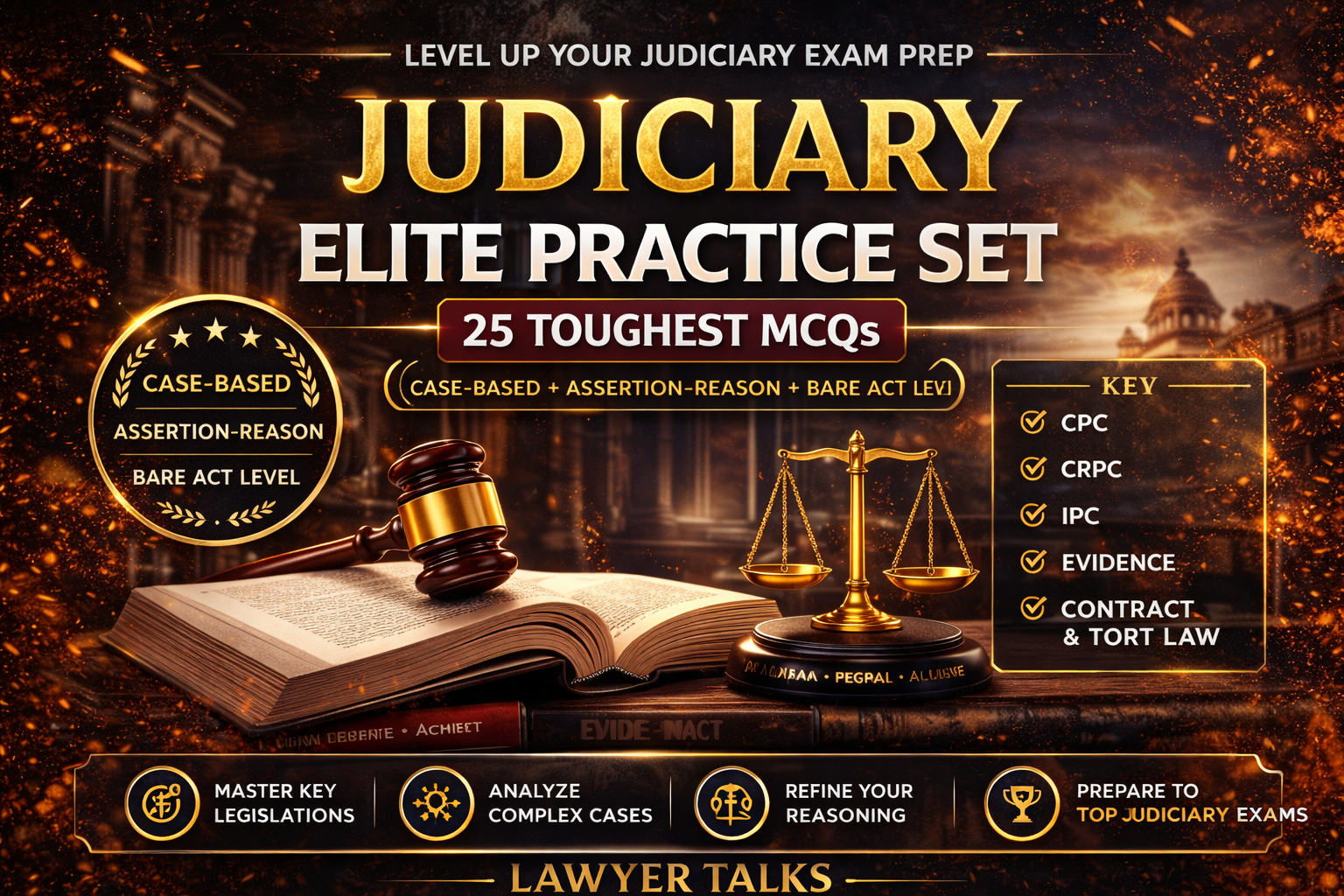
This Judiciary Elite Practice Set is designed for serious aspirants preparing for Judicial Services Examinations. It features 25 high-difficulty MCQs crafted with a mix of case-based scenarios, assertion-reason questions, and Bare Act-oriented traps.
The set covers core subjects including CPC, CrPC, IPC, Evidence Act, Contract Law, and Tort Law, focusing on conceptual clarity, legal application, and exam-level precision. Each question is structured to reflect the actual difficulty and pattern of judiciary exams, helping aspirants develop strong analytical and problem-solving skills.
Best suited for: Judiciary aspirants, law graduates, and serious candidates aiming for top ranks in competitive judicial exams.
1. (Assertion–Reason)
Assertion (A): A decree passed by a court without subject-matter jurisdiction is nullity.
Reason (R): Jurisdiction cannot be conferred by consent.
A. Both A and R true, R explains A
B. Both true, not explanation
C. A true, R false
D. A false, R true
Answer: A
2. (Case-Based) A files suit in wrong court. Defendant participates without objection. Later he challenges jurisdiction. Result?
A. Suit valid
B. Jurisdiction waived
C. Decree void
D. Only appeal allowed
Answer: B (territorial/pecuniary)
3.Which of the following is NOT an essential ingredient of res judicata?
A. Same parties
B. Same issue
C. Final decision
D. Same relief
Answer: D
4.A confession leading to discovery is admissible under:
A. Section 24 Evidence Act
B. Section 25
C. Section 27
D. Section 30
Answer: C
5. (Case-Based) A, under grave and sudden provocation, kills B instantly. Offence?
A. Murder
B. Culpable homicide not amounting to murder
C. Hurt
D. No offence
Answer: B
6. (Multi-Statement) Which are correct?
Admission is substantive evidence
Confession is stronger than admission
Admission can be used in civil cases
A. 1 and 3
B. 2 and 3
C. 1, 2, 3
D. 1 only
Answer: A
7.Which statement is correct?
A. FIR is substantive evidence
B. FIR is not evidence at all
C. FIR can corroborate or contradict
D. FIR is conclusive proof
Answer: C
8. (Case-Based) A person accused of offence is compelled to give handwriting sample. It violates:
A. Article 14
B. Article 20(3)
C. Article 21
D. No violation
Answer: D
9. (Assertion–Reason)
Assertion (A): Motive is irrelevant if direct evidence exists.
Reason (R): Motive is not a sine qua non for conviction.
A. Both true, R explains A
B. Both true, not explanation
C. A false, R true
D. A true, R false
Answer: A
10.Which is NOT a ground for temporary injunction?
A. Prima facie case
B. Balance of convenience
C. Irreparable injury
D. Monetary loss only
Answer: D
11. (Case-Based) A agrees to sell property but later refuses. Remedy?
A. Damages only
B. Specific performance
C. Injunction only
D. No remedy
Answer: B
12.Which is NOT an ingredient of theft?
A. Dishonest intention
B. Movable property
C. Consent
D. Taking out of possession
Answer: C
13.Burden of proof shifts when:
A. Always
B. Never
C. Prima facie case established
D. Judge decides
Answer: C
14. (Assertion–Reason)
Assertion (A): Double jeopardy applies after acquittal or conviction.
Reason (R): A person cannot be prosecuted twice for same offence.
A. Both true, R explains A
B. Both true, not explanation
C. A false, R true
D. A true, R false
Answer: A
15.Which is NOT an exception to consideration?
A. Natural love and affection
B. Past voluntary act
C. Agency
D. Illegal object
Answer: D
16. (Case-Based) A enters contract under mistake of fact essential to agreement. Result?
A. Valid
B. Void
C. Voidable
D. Illegal
Answer: B
17.Which of the following is correct?
A. Appeal is inherent right
B. Appeal must be provided by statute
C. Revision is right
D. Review is right
Answer: B
18.Which is NOT essential for negligence?
A. Duty
B. Breach
C. Damage
D. Intention
Answer: D
19. (Case-Based) A shoots at B but misses. Liability?
A. No offence
B. Attempt to murder
C. Hurt
D. Negligence
Answer: B
20.Which of the following is correct?
A. Estoppel creates cause of action
B. Estoppel is rule of evidence
C. Estoppel applies only in civil law
D. Estoppel is substantive law
Answer: B
21. (Multi-Statement) Which are correct?
Minor cannot contract
Minor can be beneficiary
Minor agreement is void ab initio
A. 1 and 3
B. 2 and 3
C. 1, 2, 3
D. 1 only
Answer: C
22.Which of the following is NOT a general exception?
A. Insanity
B. Mistake of fact
C. Mistake of law
D. Private defence
Answer: C
23. (Case-Based) A gift is executed but not accepted. It is:
A. Valid
B. Void
C. Voidable
D. Enforceable
Answer: B
24. (Assertion–Reason)
Assertion (A): Res sub judice prevents parallel litigation.
Reason (R): It avoids conflicting judgments.
A. Both true, R explains A
B. Both true, not explanation
C. A false, R true
D. A true, R false
Answer: A
25.Which of the following is correct?
A. All illegal agreements are void
B. All void agreements are illegal
C. Both same
D. None
Answer: A
– Team Lawyer Talks