
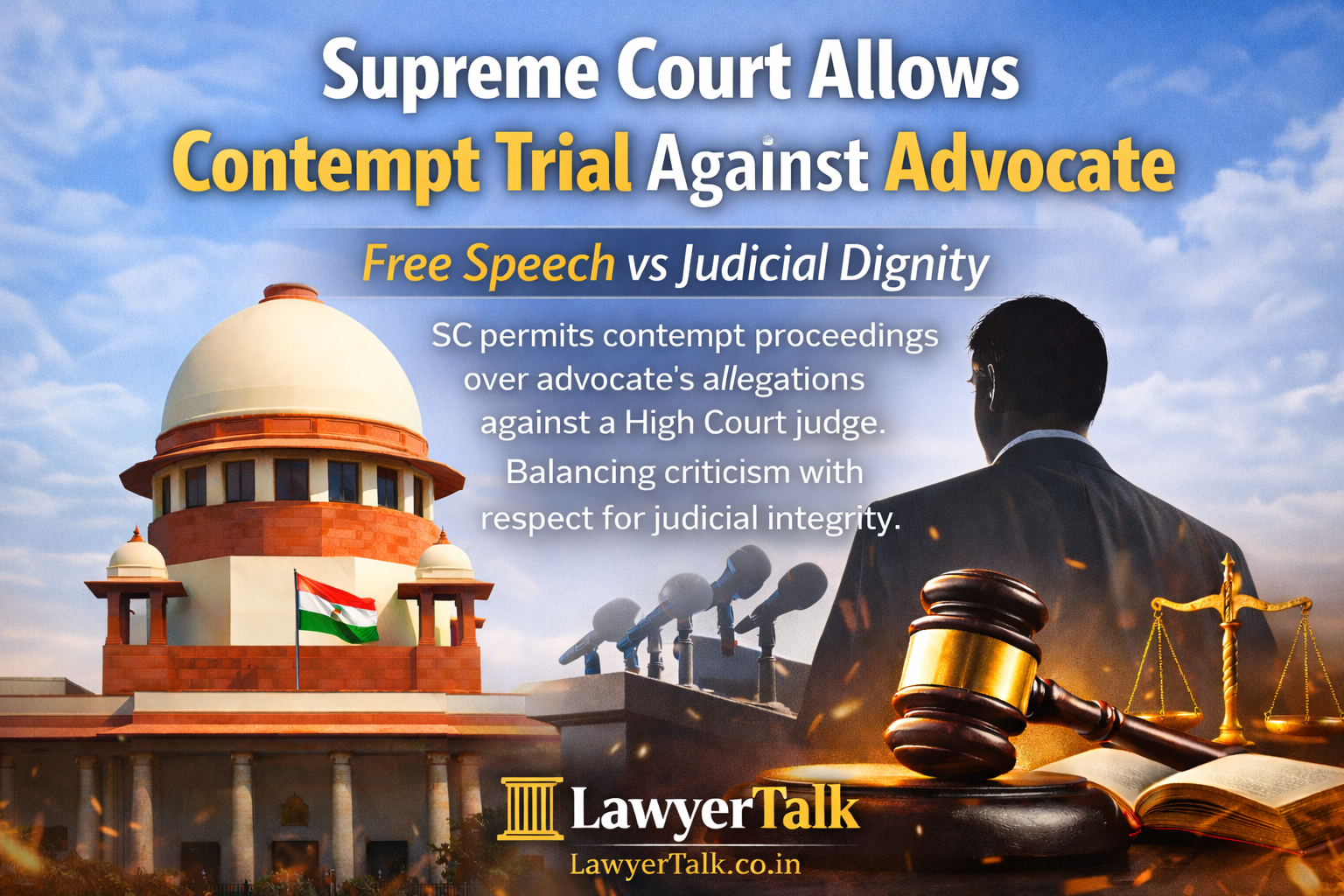
In a major move that has come as a relief to the fine line between freedom of expression and judicial decency, the Supreme Court of India has given a green light to commencement of contempt proceedings against an advocate who brought forth serious allegations against a High Court judge in a press conference. The case again raises the issue of the limits of criticism of the judiciary and the role of legal professionals in upholding institutional esteem.
Background of the Case
The scandal erupted when a lawyer accused publicly a current judge of a High Court, which cast doubt on the integrity and behaviour of the judge. These are some of the things that were said during a press interaction, which spread widely and caused judicial scrutiny.
A petition was then filed to take action against criminal contempt because such utterances were not just critical but rather scandalous statements which could undermine the confidence of people in the court.
Supreme Court’s Observation
In considering the issue, the Supreme Court of India underlined that:
- There is freedom of criticism of the judiciary, which should not be beyond reasonable limits.
- Reckless, unproven and allegations that can destroy the trust of people may be subject to contempt jurisdiction.
- Attorneys, especially advocates, are supposed to promote the dignity of the institution they represent.
The Court ruled that the contempt allegations have a prima facie content and the trial could be held, which made it obvious that the matter had to be investigated further.
Contempt of Court: A Legal View
Criminal contempt under the Contempt of Courts Act, 1971, consists of:
- The scandalizing or would scandalize, of the power, of any court;
- Actions that reduce or disrupt the due process of the law;
- Actions which hinder the administration of justice.
This case belongs to the former category-which is generally called as scandalizing the court.
Nevertheless, the law acknowledges fair and reasonable criticism as a defense but on the condition that it is done in good faith and in the best interest of the people.
Free Speech vs Judicial Accountability
The case rekindles a longstanding controversy: What is the boundary between freedom of speech and contempt?
Article 19(1) (a) of the Constitution establishes the right to freedom of speech but must reasonably be limited in case of contempt of court. Although transparency and accountability are essential in a democratic society, false accusations, particularly by the members of the law fraternity, have the power to undermine institutional credibility.
The ruling of the Court suggests that freedom of expression is not applicable to make unfounded allegations that can tarnish the image of the judiciary.
Implications for the Legal Fraternity
This decision sends a good message to activists and law professionals:
- Working against judges should be done cautiously and responsibly in terms of public statements.
- Ethics require professionals to resolve their grievances within the right channels of law instead of the society.
- The justice system is obliged to be credible.
Conclusion
Allowing the contempt proceedings to be conducted has once again confirmed the Supreme Court of India that it is keen on ensuring that dignity of the judiciary is upheld without limiting to constructive criticism.
The results of the case will also be monitored closely, as they can also establish the boundaries of what can be said in relation to courts of law. In the meantime, the word is obvious: criticisms are welcome, but not recklessness.
– Team Lawyer Talks