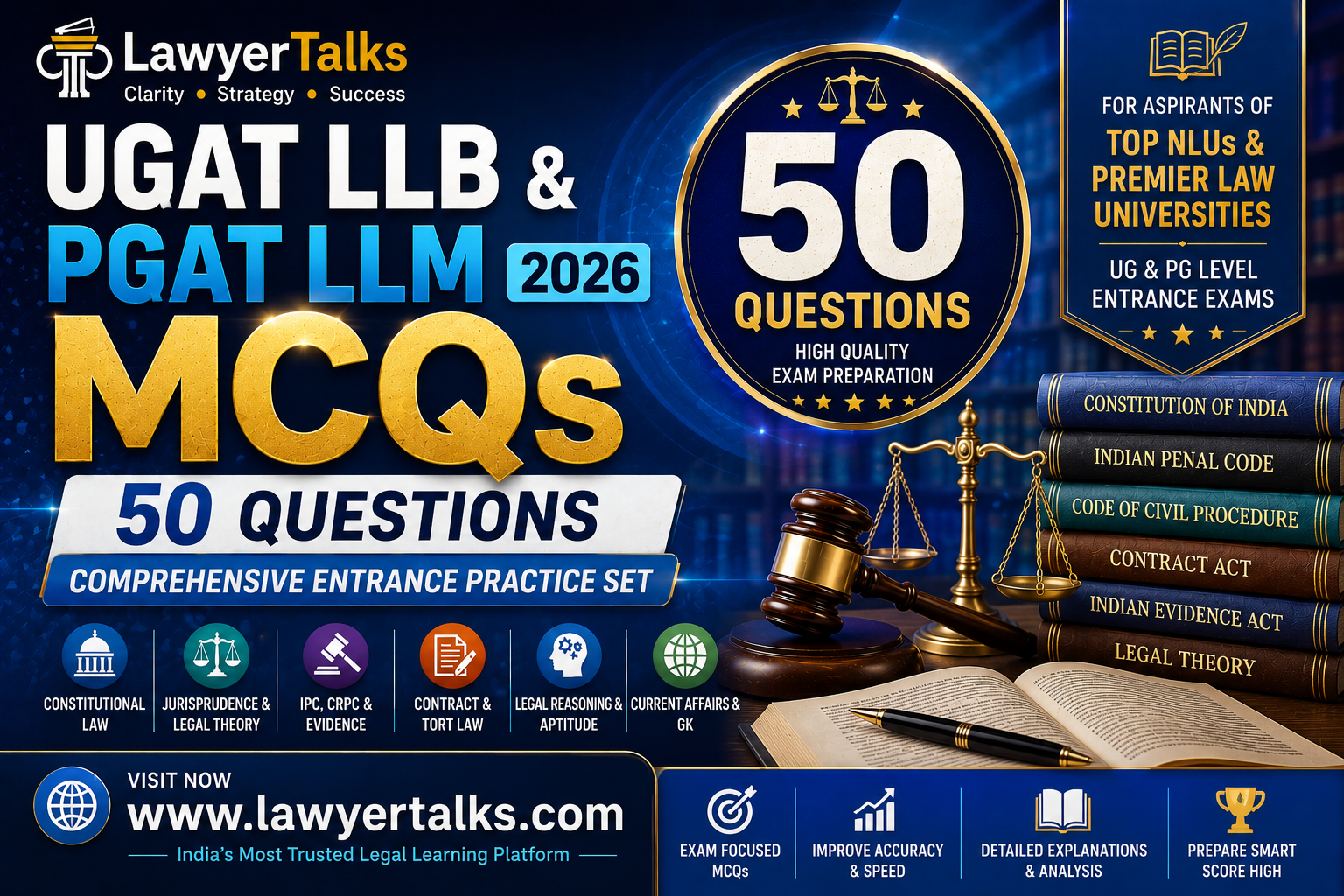
Boost your preparation for UGAT LLB and PGAT LLM 2026 with this specially curated set of 50 MCQs covering Legal Aptitude, Constitutional Law, Jurisprudence, IPC, Contract, English Reasoning, and Current Legal Awareness. Designed for both undergraduate and postgraduate law entrance aspirants aiming for top scores.
1. Article 14 of the Constitution guarantees:
A. Freedom of speech
B. Equality before law
C. Right to religion
D. Right to property
Answer: B
2. True or False: Article 32 itself is a Fundamental Right.
Answer: True
3. “Audi alteram partem” means:
A. No one should judge own case
B. Hear the other side
C. Law is supreme
D. Delay defeats equity
Answer: B
4. The Preamble of Indian Constitution was amended by:
A. 24th Amendment
B. 42nd Amendment
C. 44th Amendment
D. 52nd Amendment
Answer: B
5. “Rule of Law” concept is associated with:
A. Dicey
B. Austin
C. Kelsen
D. Bentham
Answer: A
6. True or False: Parliament can destroy the basic structure of Constitution.
Answer: False
7. IPC stands for:
A. Indian Penal Code
B. International Penal Code
C. Indian Procedure Code
D. Internal Penal Code
Answer: A
8. Theft is defined under:
A. Section 378 IPC
B. Section 390 IPC
C. Section 420 IPC
D. Section 499 IPC
Answer: A
9. “Mens rea” generally means:
A. Guilty act
B. Guilty intention
C. Wrongful gain
D. Negligence
Answer: B
10. True or False: Every murder is culpable homicide.
Answer: True
11. Common intention is embodied under:
A. Section 34 IPC
B. Section 149 IPC
C. Section 120A IPC
D. Section 511 IPC
Answer: A
12. Criminal conspiracy is defined under:
A. Section 107 IPC
B. Section 120A IPC
C. Section 149 IPC
D. Section 503 IPC
Answer: B
13. “Volenti non fit injuria” is defence in:
A. Contract
B. Tort
C. Crime
D. Evidence
Answer: B
14. Rylands v. Fletcher established:
A. Negligence
B. Absolute liability
C. Strict liability
D. Vicarious liability
Answer: C
15. True or False: Negligence requires duty of care.
Answer: True
16. “Injuria sine damno” means:
A. Damage without injury
B. Legal injury without actual damage
C. No remedy
D. Tort without fault
Answer: B
17. Consideration under Indian Contract Act may move from:
A. Promisee only
B. Promisor only
C. Third party
D. Court
Answer: C
18. Minor’s agreement is:
A. Voidable
B. Illegal
C. Void ab initio
D. Enforceable
Answer: C
19. True or False: Every agreement is a contract.
Answer: False
20. “Consensus ad idem” means:
A. Compensation
B. Meeting of minds
C. Estoppel
D. Legal injury
Answer: B
21. FIR is registered under:
A. Section 154 CrPC
B. Section 161 CrPC
C. Section 164 CrPC
D. Section 173 CrPC
Answer: A
22. Anticipatory bail is provided under:
A. Section 436 CrPC
B. Section 437 CrPC
C. Section 438 CrPC
D. Section 439 CrPC
Answer: C
23. True or False: FIR is substantive evidence.
Answer: False
24. Dying declaration is relevant under:
A. Section 24 Evidence Act
B. Section 32 Evidence Act
C. Section 45 Evidence Act
D. Section 65 Evidence Act
Answer: B
25. Estoppel is provided under:
A. Section 114 Evidence Act
B. Section 115 Evidence Act
C. Section 116 Evidence Act
D. Section 117 Evidence Act
Answer: B
26. True or False: Hearsay evidence is generally inadmissible.
Answer: True
27. “Ubi jus ibi remedium” means:
A. Ignorance excuses no one
B. Equity follows law
C. Where there is a right, there is a remedy
D. Law is supreme
Answer: C
28. Res judicata is contained under:
A. Section 9 CPC
B. Section 10 CPC
C. Section 11 CPC
D. Section 80 CPC
Answer: C
29. Caveat is filed under:
A. Section 144 CPC
B. Section 148A CPC
C. Section 151 CPC
D. Section 80 CPC
Answer: B
30. True or False: Appeal is a statutory right.
Answer: True
31. “Pacta sunt servanda” relates to:
A. Criminal law
B. Constitutional law
C. International law
D. Tort law
Answer: C
32. Universal Declaration of Human Rights was adopted in:
A. 1945
B. 1948
C. 1950
D. 1966
Answer: B
33. True or False: ICJ has compulsory jurisdiction over all disputes.
Answer: False
34. “Volksgeist” theory is associated with:
A. Austin
B. Savigny
C. Kelsen
D. Pound
Answer: B
35. Roscoe Pound described law as:
A. Sovereign command
B. Social engineering
C. Natural justice
D. Legal fiction
Answer: B
36. True or False: Kelsen propounded Pure Theory of Law.
Answer: True
37. Synonym of “Lucid” is:
A. Confusing
B. Clear
C. Weak
D. Complex
Answer: B
38. Antonym of “Benevolent” is:
A. Kind
B. Helpful
C. Cruel
D. Generous
Answer: C
39. Choose correct sentence:
A. He do not know law.
B. He does not knows law.
C. He does not know law.
D. He not know law.
Answer: C
40. True or False: “Reading maketh a full man” was written by Francis Bacon.
Answer: True
41. If all judges are lawyers and some lawyers are professors, then:
A. All professors are judges
B. Some judges are professors
C. Some professors may be lawyers
D. No judge is professor
Answer: C
42. Find odd one out:
A. CPC
B. IPC
C. CrPC
D. RBI
Answer: D
43. True or False: PIL stands for Public Interest Litigation.
Answer: True
44. Which case evolved Basic Structure Doctrine?
A. Golaknath
B. Kesavananda Bharati
C. Maneka Gandhi
D. Minerva Mills
Answer: B
45. Lok Adalat award is:
A. Advisory
B. Binding
C. Temporary
D. Reviewable on merits
Answer: B
46. “Nemo judex in causa sua” means:
A. Hear the other side
B. No one should judge own cause
C. Law protects rights
D. Justice delayed is justice denied
Answer: B
47. True or False: Judicial review is part of basic structure doctrine.
Answer: True
48. Standard of proof in criminal cases is:
A. Suspicion
B. Beyond reasonable doubt
C. Preponderance of probabilities
D. Prima facie proof
Answer: B
49. Standard of proof in civil cases is:
A. Beyond reasonable doubt
B. Conclusive proof
C. Preponderance of probabilities
D. Suspicion
Answer: C
50. Which Article guarantees constitutional remedies?
A. Article 19
B. Article 21
C. Article 32
D. Article 14
Answer: C
– Team Lawyer Talks